
Best GrowAce Alternatives for Indoor Setups
Table of Contents
- Why Growers Switch from GrowAce to Alternative Indoor Growing Systems
- Indoor Grow Tent Kits: Complete Systems vs Component-by-Component Setup
- Grow Lights for Indoor Plants: LED Performance and Coverage
- Hydroponic Growing Systems for Home: Soil vs Water-Based Methods
- Indoor Herb Growing Kits: Compact Solutions for Small Spaces
- Maxibright Varidrive LED Range: Flexibility Across Growing Stages
- GorillaBox Grow Tents: Build Quality and Environmental Control
- Complete Setup Cost Breakdown: What You'll Actually Spend
- Frequently Asked Questions
Last Updated: October 21, 2026
Why Growers Switch from GrowAce to Alternative Indoor Growing Systems
Equipment choice determines your yields, energy bills, and space needs. Many growers start with basic kits, then outgrow them or find their lights don't deliver the right spectrum at every stage.
No single system works for everyone: a compact herb kit suits a small flat, while a serious vegetable grower needs something entirely different.
This guide breaks down what each GrowAce alternative offers, what it costs to set up and run, and who it suits.
Indoor Grow Tent Kits: Complete Systems vs Component-by-Component Setup
An indoor grow tent creates a controlled environment where you manage light, temperature, humidity, and airflow, keeping light in and pests out. You have two paths: a pre-assembled kit or a component-by-component build, each with genuine trade-offs.
Pre-assembled Kits vs Building Your Own
Pre-assembled kits save time and eliminate guesswork, but you're locked into the manufacturer's lighting, ventilation, and capacity choices, and outgrowing one means buying a new kit rather than upgrading pieces.
Building your own system takes more research but gives complete control: you pick the tent size, lights, and ventilation to match your space and plants, and upgrade components as needs change.
Startup Costs and Long-Term Value
A basic pre-assembled kit typically costs £300-600, covering the tent, LED light, basic ventilation, and accessories.
Long-term value shifts when you factor in electricity and durability. A high-efficiency LED costs more upfront but uses far less electricity than older HPS lighting, and quality tents with reinforced frames last multiple cycles while cheaper ones tear, fail at the zips, and leak light.
Grow Lights for Indoor Plants: LED Performance and Coverage
Your grow light is the most important piece of equipment, determining growth speed, canopy density, and yield. LEDs run cooler, use less electricity, and deliver better spectrum control than HPS. Evaluate lights on three things: total light output (µmol/s or PPF), spectrum, and efficiency (µmol/J or PPE).
Full-Spectrum Output and Dimmable Control
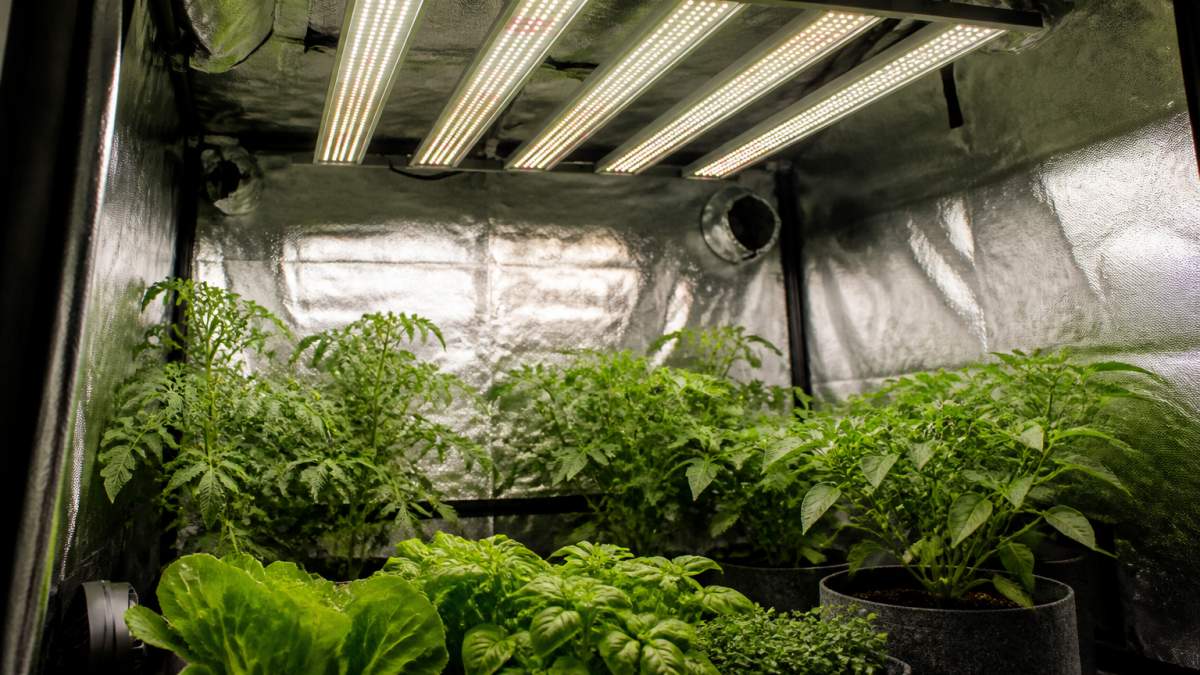
Full-spectrum LEDs emit light across the wavelengths plants need throughout their lifecycle: more blue for seedlings and vegetative growth, more red for flowering.
The Maxibright Varidrive 720W LED is designed exactly for this approach.
For larger setups, the Maxibright Varidrive 500W/1000W LED offers genuine flexibility. Run it as a single 1000W fixture or split it into two independent 500W units.
Coverage Area and Growing Space Efficiency
Coverage area determines how much canopy you light effectively. A 720W LED covers roughly 1.5 × 1.5 metres at appropriate intensity; a 1000W fixture handles 1.5 × 1.8 to 1.8 × 1.8 metres.
A common approach is to use multiple smaller lights rather than one large one: two 500W fixtures give more even coverage than a single 1000W unit, especially in rectangular spaces.
Hydroponic Growing Systems for Home: Soil vs Water-Based Methods
Hydroponics is straightforward: plants grow in water or an inert medium, and you deliver nutrients directly to the roots. Soil-based growing is more forgiving, with compost buffering mistakes and nutrients releasing gradually. Hydroponics is more precise: plants grow faster and less water is used because it recirculates, but you must monitor pH, nutrient concentration, and water temperature carefully, where mistakes show up quickly.
Nutrient Uptake and Yield Performance
In soil, nutrients become available as plants need them, giving margin for error. In hydroponics, nutrients are dissolved in water and absorbed immediately, which can lead to faster growth and higher yields. For herbs and leafy greens, hydroponics can produce faster growth than soil; for fruiting plants the advantage can be smaller because light and temperature become limiting. Soil is also a sustainable option for many home growers: living soil can improve over time and be reused.
Maintenance Requirements and System Automation
Soil requires scheduled watering, occasional feeding, and pest checks. Hydroponics requires regular pH checks, nutrient testing, water temperature monitoring, and cleaning to prevent algae and pathogen buildup. Automation helps at extra cost. For apartment growers or anyone with limited time, soil-based growing in a grow tent is simpler, while hydroponics offers better yields but demands more attention.
Indoor Herb Growing Kits: Compact Solutions for Small Spaces
Not everyone has room for a full grow tent. Compact indoor herb kits fill the gap for apartment dwellers or anyone growing a few herbs on a kitchen shelf. Designed for 4-12 plants, they're self-contained with integrated lighting and water reservoirs, set up in minutes, and use minimal electricity.
Apartment-Friendly Dimensions and Noise Levels
A proper herb kit is roughly microwave-sized (30-50cm wide, 20-30cm deep, 30-40cm tall), draws as much electricity as a desk lamp, and uses passive cooling or very quiet fans, so noise is essentially zero. The tradeoff is capacity: 4-8 plants at a time. For larger plants like tomatoes or peppers you need a proper grow tent, but for herbs, lettuce, and microgreens a compact system is perfect.
Maxibright COMPACT Varidrive 720W LED With Varidrive Dimmable Ballast - (B) →
Plant Capacity and Harvest Frequency
A compact herb kit handles 4-12 plants depending on design. You can harvest individual leaves from basil or mint continuously, or rotate new seeds every two weeks for a continuous supply. Herbs like basil, parsley, and coriander go from seed to harvest in 3-4 weeks under LED lighting, and microgreens are ready in 10-14 days.
Maxibright Varidrive LED Range: Flexibility Across Growing Stages
The Maxibright Varidrive range offers fixtures designed to scale with your needs and adapt to your plants' changing requirements.
Compact 720W for Small to Medium Grows
The Varidrive 720W COMPACT delivers 1920 µmol/s across a 1.5 × 1.5 metre space, enough for 4-9 plants. The 6-bar removable design lets you customise coverage, and dimmable output from 250W to 720W means one light adapts to your entire cycle. At £175-250 with a 2-year warranty, it's a natural upgrade from basic systems.

Dual 500W/1000W for Expandable Setups
The Varidrive 500W/1000W LED is for growers whose setup will evolve. Run it as a single 1000W fixture covering 1.5 × 1.8 to 1.8 × 1.8 metres, or split it into two independent 500W units, each covering roughly 1.2 × 1.2 metres. Each unit has its own dimming control and integrated drivers mean no external ballasts. At £300, you can scale without replacing your lighting.
GorillaBox Grow Tents: Build Quality and Environmental Control
Your grow tent is the foundation everything else depends on. GorillaBox tents are built for durability: standard tents use 210D and 600D Mylar fabric with reinforced zips and a sturdy 16mm frame with plastic corners, while deluxe models step up to 25mm metal frames with welded corners and click-lock joints. That construction matters when you're loading the tent with water, soil, lights, and plants.
Light-Proof Construction and Ventilation Integration
Light leaks are the silent killer of indoor growing: even small gaps let outside light in during the dark cycle, confusing plants and reducing yields. GorillaBox standard tents deliver light-proof construction with layered Mylar fabric and careful seams, and ports are positioned to run intake and exhaust ducting efficiently. The GorillaBox 2.4m × 1.2m × 2.0m tent is popular for serious growers: large enough for 6-12 plants without dominating a room, and at £202.90 it balances cost, capacity, and durability.
Frame Durability and Long-Term Reliability
The frame takes constant stress from hanging lights, growing plants, and vibrating fans. GorillaBox standard tents handle this with a 16mm frame and plastic corners sturdy enough for years of use, while deluxe models with welded metal corners offer maximum durability. Many growers keep the same tent for 5+ years, upgrading lights and ventilation as technology improves; cheap tents start failing after 2-3 years.
Complete Setup Cost Breakdown: What You'll Actually Spend
Here's what a real indoor growing setup costs, broken down into actual components and realistic prices.
Tent, Light, and Essential Accessories
A complete small-to-medium setup looks like this:
| Component | Item | Cost |
|---|---|---|
| Tent | GorillaBox 2.4m × 1.2m × 2.0m | £202.90 |
| Grow Light | Maxibright Varidrive 720W LED (controllable ballast) | £210.00 |
| Ventilation | Carbon filter, ducting, inline fan | £120-180 |
| Accessories | Pots, soil, pH meter, thermometer, hangers | £80-120 |
| Total Startup | £613-712 |
That's a functional, quality setup. The tent is durable, the light is flexible and efficient, and you have proper ventilation to manage temperature and humidity.
If you want to expand to a larger setup with the Varidrive 500W/1000W:
| Component | Item | Cost |
|---|---|---|
| Tent | GorillaBox 2.4m × 1.2m × 2.0m (or larger) | £202.90 |
| Grow Light | Maxibright Varidrive 500W/1000W LED | £300.00 |
| Ventilation | Carbon filter, ducting, inline fan | £150-200 |
| Accessories | Pots, soil, meters, hangers, trays | £100-150 |
| Total Startup | £753-852 |
This setup handles more plants and delivers higher light intensity. You have the flexibility to split the light into two units later if you expand.

Operating Costs and Electricity Efficiency
Electricity is the ongoing cost that adds up.
The choice between GrowAce alternatives for indoor setups comes down to your space, your budget, and what you want to grow. A compact herb kit suits apartment dwellers.
At The Growers Shop, we stock all these components individually so you can build exactly the system you need rather than being forced into a pre-assembled kit that doesn't quite fit.
Frequently Asked Questions
What should I look for in a GrowAce alternative for indoor setups?
The best GrowAce alternatives balance three factors: growing space size, light output (measured in µmol/s), and total startup cost. For a 1.5 × 1.5 metre tent, you need at least 1920 µmol/s of full-spectrum light. Check whether the system offers dimmable controls so you can adjust intensity for seedlings, vegetative growth, and flowering stages. Verify the tent's light-proof construction and whether ventilation can be integrated. Most importantly, calculate the complete cost: tent, grow light, ballast or driver, ducting, and nutrients, not just the headline price of one component.
Are complete indoor grow tent kits worth buying instead of building a system piece by piece?
Complete kits save time and often cost less than sourcing each component separately, but only if they match your growing goal. Pre-assembled kits typically include a tent, light, and basic accessories at a fixed price. Building your own allows you to upgrade individual components, for example, choosing a more efficient LED or a larger tent, but requires research and compatibility checks. For beginners growing herbs in a flat, a kit is usually simpler. Serious growers often find better value buying a quality tent like the GorillaBox 2.4 × 1.2 × 2.0 metre (£202.90) and pairing it with a modular light like the Maxibright Varidrive 500W/1000W (£300.00) that can expand later.
How do hydroponic and soil-based indoor growing systems compare for home use?
Hydroponic systems deliver nutrients directly to plant roots through water, which can produce faster growth and higher yields in controlled conditions. Soil-based systems are more forgiving for beginners and require less equipment, though they demand more frequent watering and nutrient management. For indoor herb growing in a flat, soil-based setups in compact containers can be simpler and cheaper. For vegetable production or serious yields, hydroponics paired with automated watering and nutrient dosing (via app control or timers) can reduce daily maintenance. Both work in the same grow tent with the same LED lights, the choice depends on your time, budget, and harvest goals.
What's the real cost of running an indoor growing system year-round?
Operating costs centre on electricity. A Maxibright Compact Varidrive 720W LED running 12 hours daily uses approximately 8.64 kWh per day. At typical rates around £0.28-0.35 per kWh, that's roughly £2.42-3.02 per day or £883-1102 annually for lighting alone. Add ventilation fans (£100-£300 annually) and occasional nutrient restocking (£50-£200 per year depending on system type). A complete first-year setup, tent (£202.90), light (£175-£300), ballast, ducting, and initial nutrients, typically ranges from £600 to £1,200. Year two costs drop to electricity, nutrients, and occasional replacements, making it sustainable for serious growers.