
Choosing the Right Grow Tent Size: A Practical Guide
Table of Contents
- Measure Your Available Space First
- How Many Plants in a Grow Tent: Calculating Your Capacity
- Grow Tent Size for Beginners: Starting Small and Simple
- Matching Grow Light Size for Grow Tent Coverage
- Grow Tent Height: Planning Vertical Space for Plant Growth
- Account for Equipment Footprint and Ventilation
- Common Tent Dimensions and What They're Best For
- Frequently Asked Questions
Last Updated: October 12, 2026
Measure Your Available Space First
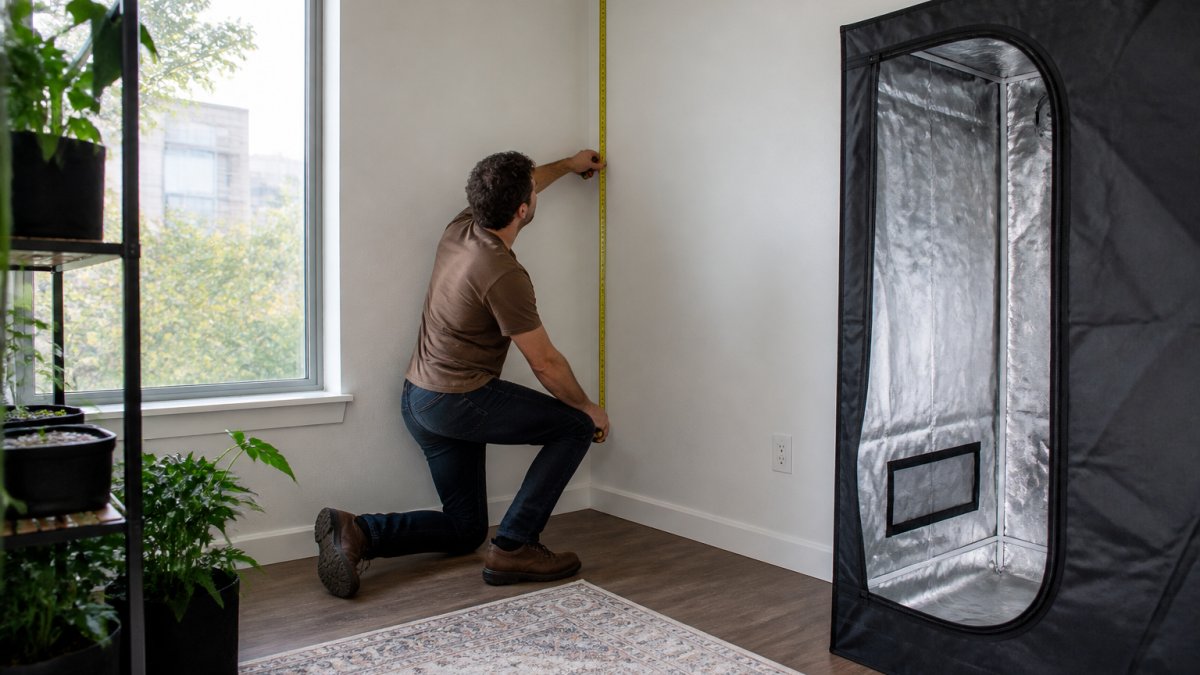
The first step in choosing the right grow tent size is measuring your available space. This determines your tent dimensions, plant capacity, and equipment layout, before you think about plant count or lights.
Measure the floor area where your grow tent will sit, length and width in centimetres, and check ceiling height. Many growers underestimate vertical clearance: you need room for grow lights, ventilation ducting, and access to water and adjust plants.
Look for obstacles: radiators, shelves, power outlets, and windows all matter. A 1.2m × 1.2m tent might fit on paper but be impossible to position if a radiator blocks one side. Your tent also needs space around it for intake and exhaust air to flow freely.
How Many Plants in a Grow Tent: Calculating Your Capacity
Plant count is not a number you look up, it is a number you calculate. Floor area sets the ceiling, but pot diameter, canopy spread, training technique, and equipment space all pull it down. Work through the four steps below to land on a realistic figure.
Step 1: Establish usable floor area. Subtract the strip occupied by your extraction fan, carbon filter, and any reservoir or humidifier. Losing 15-25% of the floor to equipment is common, so a 1m × 1m tent often gives closer to 0.75-0.85m² of genuine plant space.
Step 2: Measure your pot or container diameter. Most growers skip this. A 10-litre fabric pot is typically 25-30cm across; an 18-litre pot is 30-35cm. Two 30cm pots side by side need 60cm of width before the plants even touch. Measure the pot, not the plant.
Step 3: Decide your canopy footprint per plant. This is the area you intend each plant to fill at its widest point, and it depends on how you train it:
| Training approach | Typical canopy per plant | Notes |
|---|---|---|
| Untrained, single stem | 0.10-0.15m² | Tall and narrow; suits height-limited tents |
| Topped once or twice | 0.20-0.30m² | Bushier; the common middle ground |
| Low-stress training / SCROG | 0.30-0.50m² | Wide, flat canopy; needs a screen and more floor |
Step 4: Divide usable area by canopy footprint. A 1m × 1m tent with 0.8m² usable and plants trained to 0.25m² each gives you roughly three plants, not four. The same tent with untrained plants at 0.12m² each could hold six, but they will be tall and thin and harder to light evenly.
A worked example: a 1.2m × 1.2m tent (1.44m² gross) minus 0.25m² for a corner-mounted filter and fan leaves about 1.19m². At a 0.3m² canopy per plant, that fits three comfortably, or four with tighter training and diligent pruning.
Growing method shifts the maths again. Hydroponic systems with a shared reservoir free up floor space that soil pots would occupy, but the reservoir itself needs a footprint. Soil grows are simpler to plan because each pot is a known size.
Grow Tent Size for Beginners: Starting Small and Simple
If you're new to indoor growing, start small. A small tent teaches the fundamentals without overwhelming you. The GorillaBox Tent 0.6m × 0.6m × 1.6m is ideal for beginners: affordable, manageable, and it shows how lighting, ventilation, and plant care work together without the complexity of a large setup.
Small tents are forgiving: they heat and cool faster, hold humidity more consistently, and let you see all your plants without moving equipment. When something goes wrong, fewer plants are affected, so the learning curve is gentler.
A small tent also lets you test your space, whether the room stays warm enough, whether humidity is a problem, and whether you have adequate electrical capacity. These lessons transfer to larger setups later.
The GorillaBox Tent 1.0m × 1.0m × 2.0m is the natural next step. It doubles your growing area and works well for 2-4 plants. It's still manageable for one person to set up and maintain.
Beginner growers often jump to large tents and regret it. A 1.2m × 1.2m tent can be overwhelming if you're learning. Start small, succeed, then upgrade.
Matching Grow Light Size for Grow Tent Coverage
Your grow light must cover the entire canopy. An undersized light leaves dark corners where plants weaken. An oversized light wastes energy and costs more than necessary.
Coverage depends on light type and distance from plants. LED lights cover a specific footprint, often listed in the specs: a 600W LED might cover 1.2m × 1.2m at the right distance, while a 400W LED covers roughly 1m × 1m.
The tent dimensions should roughly match your light footprint. A 1m × 1m tent works best with a light rated for 1m² coverage. A 1.2m × 1.2m tent needs a light rated for 1.4m² coverage (accounting for edge falloff).
Light height also affects coverage. Too high spreads energy over a larger area at lower intensity; too close can burn leaves. Most growers position lights 30-60cm above the canopy, depending on light type and plant stage (Artificial Lighting for Indoor Plants).
Grow Tent Height: Planning Vertical Space for Plant Growth
Tent height determines how tall your plants can grow before hitting the light. This matters more than many growers realize.
A standard tent height is 2.0m, but it fills up quickly: the light hangs 10-15cm from the roof and plants need 30-60cm clearance, leaving roughly 1.2-1.5m for actual growth.
If you're growing from seed, that's plenty. If you're growing clones or mother plants that stay in vegetative growth for months, they can outgrow a 2.0m tent.
GorillaBox Tent 1.2m x 1.2 x 2.0 (White) →
Some growers use shorter tents deliberately. A 1.6m tent is common for space-constrained setups and forces plants to stay shorter, which suits certain growing methods.
Plan tent height around your intended plant size and growing method. Vegetative plants grow taller; flowering plants are usually kept compact through pruning or training.
Account for Equipment Footprint and Ventilation
Most sizing guides treat the tent as a box for plants. In practice it is a box for plants plus a filter, fan, ducting, reservoir, humidifier, and the space to reach past them.
Equipment footprints to budget for. These are typical ranges, not fixed figures, check your own kit:
| Item | Typical footprint | Where it sits |
|---|---|---|
| Carbon filter + inline fan | 0.10-0.20m² | Top corner, hung from the frame |
| Ducting runs | 10-15cm wide | Along a wall or ceiling, to a port |
| Reservoir or auto-watering tank | 0.15-0.30m² | Floor, usually outside or at one end |
| Humidifier / dehumidifier | 0.05-0.15m² | Floor or shelf |
| Oscillating fan | 0.03-0.05m² | Corner or clipped to a pole |
| Heater or controller unit | 0.05-0.10m² | Floor, near an intake |
Add those up and you can easily lose a quarter of the floor before a single pot goes in. A 1m × 1m tent with a filter, fan, reservoir, and humidifier may have only 0.6-0.7m² of genuine plant space.
Usable interior dimensions are smaller than the label. Tent sizes are quoted as external or nominal dimensions.
Access clearance matters as much as floor area. You need to open the door fully, reach the back row, and get water to every pot. A tent pushed against walls on three sides is technically the right size but practically unusable.
Ventilation scales with tent volume, not floor area. A taller tent holds more air and needs more extraction to achieve the same air changes per hour. As a working guide, most growers aim to replace the tent's full air volume every one to three minutes during lights-on.
Plan the electrical load at the same time. Lights, extraction, circulation fans, heating, and humidification all draw from the same circuit. Add up the wattage you intend to run and check it against the circuit's rating.
Heat is the hidden sizing constraint. A larger tent with more light generates more heat, needing more extraction. A small tent with modest lighting is easier to keep stable.
Common Tent Dimensions and What They're Best For
Several tent sizes have become standard because they balance cost, usability, and effectiveness.
0.6m × 0.6m × 1.6m, The starter tent. Fits in a corner of a bedroom or closet. Holds 1-2 plants. Good for learning. Limited space for equipment. Best for beginners or very tight spaces. The GorillaBox Tent 0.6m × 0.6m × 1.6m costs £67.64.
1.0m × 1.0m × 2.0m, The workhorse. Fits most small rooms. Holds 2-4 plants depending on size. Enough space for equipment and airflow. Works for vegetative and flowering stages. The GorillaBox Tent 1.0m × 1.0m × 2.0m starts at £110.52 for the standard version and £144.00 for the white version.
1.2m × 1.2m × 2.0m, The mid-size tent. Fits a spare room or garage corner. Holds 4-6 plants. More room for equipment and air circulation. Better light distribution. The GorillaBox Tent 1.2m × 1.2m × 2.0m costs £160.00.
Larger tents exist (1.5m, 2.0m, and bigger) but require dedicated space and more complex ventilation. They're better suited to serious growers with established setups.
At The Growers Shop, we stock GorillaBox tents in these standard sizes because they represent the best balance between usability and plant capacity for most growers. Each size uses heavy-duty 600D Mylar fabric and sturdy frames that maintain light-proof integrity, essential for controlling your growing environment.
Choosing the right grow tent size comes down to three things: your available space, how many plants you want to grow, and your experience level. Measure your space first, calculate realistic plant capacity, and start smaller than you think you need.
At The Growers Shop, we recommend matching your tent size to your space and experience, then selecting equipment that fits that tent properly. Start with a size that feels manageable, and you'll build the skills and confidence to expand later. Royal Horticultural Society guidance on indoor growing environments confirms that proper space planning and environmental control are foundational to successful cultivation.
Frequently Asked Questions
How big should my grow tent be?
Grow tent size depends on your available floor space, plant count, and equipment needs. Start by measuring your room and accounting for ventilation ducting and equipment footprint. A 0.6m × 0.6m tent suits 1-2 plants in a small flat, whilst a 1.2m × 1.2m tent accommodates 4-6 plants with proper spacing. Choose a size that leaves at least 30cm clearance around the tent for airflow and access.
What size grow tent is best for beginners?
A 1.0m × 1.0m grow tent is ideal for beginners. It offers enough space to grow 2-4 plants without overwhelming you with complexity, fits most apartment corners, and keeps equipment costs manageable. The GorillaBox Tent 1.0m × 1.0m × 2.0m (£144) provides sturdy construction and light-proof design, making it a reliable starting point for learning temperature and humidity control.
How do I match a grow light to my grow tent size?
Grow light size must match your tent's floor area. A standard LED grow light covers roughly 1 square metre, so a 1.0m × 1.0m tent needs one quality light. Larger tents like 1.2m × 1.2m (1.44 square metres) may benefit from two smaller lights or one high-output fixture. Check the light's coverage specifications and ensure it sits 30-60cm above your canopy to avoid heat stress and light burn.
What height should my grow tent be?
Grow tent height must accommodate your plants at full size plus equipment. Most tents are 1.6m-2.0m tall. A 2.0m tent leaves room for a light fixture (15-20cm), plant growth (60-100cm depending on strain), and airflow space above the canopy. If you're growing herbs or seedlings, a 1.6m tent suffices. For flowering plants or tall vegetative growth, choose 2.0m to avoid cramping your setup.