

How to Control Humidity in Grow Tent: Step-by-Step
Table of Contents
- Why Humidity Control Matters in Your Grow Tent
- What You'll Need Before You Start
- How to Lower Humidity in a Grow Tent
- How to Increase Humidity in a Grow Tent
- Grow Tent Humidity by Growth Stage
- Using a Grow Tent Dehumidifier for Consistent Control
- Common Mistakes to Avoid When Managing Humidity
- Frequently Asked Questions
Last Updated: October 8, 2026
Why Humidity Control Matters in Your Grow Tent
Learning how to control humidity in grow tent environments is one of the most critical factors for healthy plant growth. Too much moisture and you risk mould, mildew, and root rot. Too little and your plants struggle to absorb nutrients and regulate temperature. Getting this balance right transforms your growing environment from unpredictable to stable.
The sweet spot varies by growth stage. Seedlings thrive in higher humidity around 65-70%. Vegetative plants do well at 50-70%. Flowering plants need lower humidity, typically 40-50%, to prevent bud rot and encourage resin production. Without proper humidity control, even the best lights and nutrients won't deliver results.
Humidity affects every aspect of plant physiology. It influences how plants transpire water, absorb nutrients through their leaves, and regulate their internal temperature. When humidity swings wildly, plants go into stress mode. Stress stunts growth and opens the door to problems.
What You'll Need Before You Start
Before adjusting humidity, you need to measure it accurately. A basic thermometer and hygrometer combo is essential.
Measurement tools:
- Digital thermometer and hygrometer to monitor current conditions
- A hygrometer with min/max memory to track fluctuations over time
- Consider a CO₂ monitor if you're serious about optimisation
The Maxibright Min/Max Thermometer & Hygrometer with Probe gives you internal and external temperature readings plus humidity tracking with frost-point alarm. It's the foundation of any serious humidity management system.
For lowering humidity, you'll need:
- Ventilation fan or ducting system
- Dehumidifier if your space is naturally damp
- Hygrometer to confirm changes are working
For raising humidity, you'll need:
- Humidifier or spray bottle
- Humidity meter to avoid overshooting
- Proper air circulation to prevent stagnant pockets
Start by measuring your current conditions for 24-48 hours. Record morning, midday, and evening readings. This baseline tells you whether you're fighting naturally high or low humidity.
How to Lower Humidity in a Grow Tent
High humidity is the enemy of indoor growing. Mould thrives in moist air, and plants can't transpire properly when the air is already saturated with water vapour.
Start with ventilation. A basic exhaust fan pulling moist air out of the tent is often enough. Aim to exchange all the air in your tent every 1-3 minutes. If your tent is 1.2m × 1.2m × 2m, you need a fan that moves at least 300-400 cubic metres per hour.
Position the intake low and exhaust high. This creates a natural flow that pulls moisture-laden air out before it settles on plants. Use ducting to route hot, humid air outside the growing area entirely.
Increase air circulation inside the tent. A small oscillating fan running continuously helps. It breaks up humid microclimates around plant canopies where mould loves to hide. Don't point the fan directly at plants, let it create gentle movement across the whole space.
Reduce watering frequency. Overwatering is often the real culprit. Soil releases moisture into the air as it dries. Let the top inch of soil dry between waterings. Use pots with drainage holes and remove standing water from saucers immediately.
Lower temperature slightly. Warm air holds more moisture. A 2-3 degree drop in temperature can noticeably reduce relative humidity. This works best in combination with ventilation.
For stubborn cases, use a dehumidifier. The Gorilla Electric Dehumidifier 26L/Day removes up to 26 litres of water daily from your growing space. It features an intelligent micro-computer control system, continuous drainage option, and automatic shut-off when the tank fills. This removes the guesswork from humidity management.
How to Increase Humidity in a Grow Tent
Low humidity causes leaf damage, slow growth, and stressed plants. Seedlings and clones are especially vulnerable. Dry air pulls moisture from leaves faster than roots can replace it.
Use a humidifier. Ultrasonic or warm-mist models work well in grow tents. They're affordable and effective. Run one for 10-15 minutes in the morning and evening, then monitor. Overhumidifying is easy, so start conservative.
Spray plants lightly. A fine mist bottle applied to leaves in the morning helps, but this only works temporarily. The moisture evaporates quickly. Use this as a supplement, not your main strategy.
Reduce ventilation temporarily. If humidity is too low, dial back your exhaust fan speed. Less air movement means moisture stays in the tent longer. But don't eliminate ventilation entirely, plants need fresh air and CO₂.
Group plants closer together. Plants release moisture through transpiration. When they're clustered, they create a more humid microclimate around each other. This works especially well for seedlings.
Use a humidity dome or propagation chamber. For clones and seedlings, a clear plastic dome traps moisture around young plants. Raise it slightly as they establish, gradually reducing humidity as roots develop.
Add a water reservoir near the plants. Passive evaporation from standing water raises humidity slowly. This is gentler than active humidification but less reliable.
Monitor closely when raising humidity. The goal is to hit your target range, not create a swamp. Stagnant, overly humid air breeds problems faster than dry air.
Grow Tent Humidity by Growth Stage
Different stages demand different humidity levels. Understanding this prevents common mistakes like keeping seedlings too dry or flowering plants too wet.
Seedling stage (0-2 weeks): Target 65-75% humidity. Young plants have tiny root systems that can't absorb water fast enough. High humidity reduces the stress of transplanting and establishment. Use a humidity dome and check daily. Once the first true leaves appear, gradually reduce humidity.
Gorilla Electric Dehumidifier 26L/Day →
Vegetative stage (2-8 weeks): Aim for 50-70% humidity. Plants are establishing roots and building foliage. They can handle moderate humidity without disease risk. This is the most forgiving stage for humidity management.
Pre-flowering transition (1-2 weeks): Drop to 50-60%. As plants shift energy toward flower production, they need less vegetative support. Begin reducing humidity gradually to prepare them.
Flowering stage (6-10 weeks): Keep humidity at 40-50%. This is critical. Dense flower buds trap moisture and encourage bud rot and powdery mildew. Lower humidity forces plants to focus energy on resin production rather than vegetative growth. Many growers drop humidity even further, to 30-40%, in the final 2-3 weeks.
Late flowering (final 2 weeks): 30-40% humidity. Very low humidity stresses the plant slightly, triggering a resin boost as a survival mechanism. This is where premium quality develops.
The transition between stages matters. Don't drop humidity suddenly, adjust it over 3-5 days. Sudden swings stress plants and trigger problems.
Using a Grow Tent Dehumidifier for Consistent Control
Understanding how to control humidity in grow tent with a dehumidifier removes the guesswork from humidity management. Instead of juggling fans, ventilation, and watering schedules, you set a target and the unit maintains it automatically.
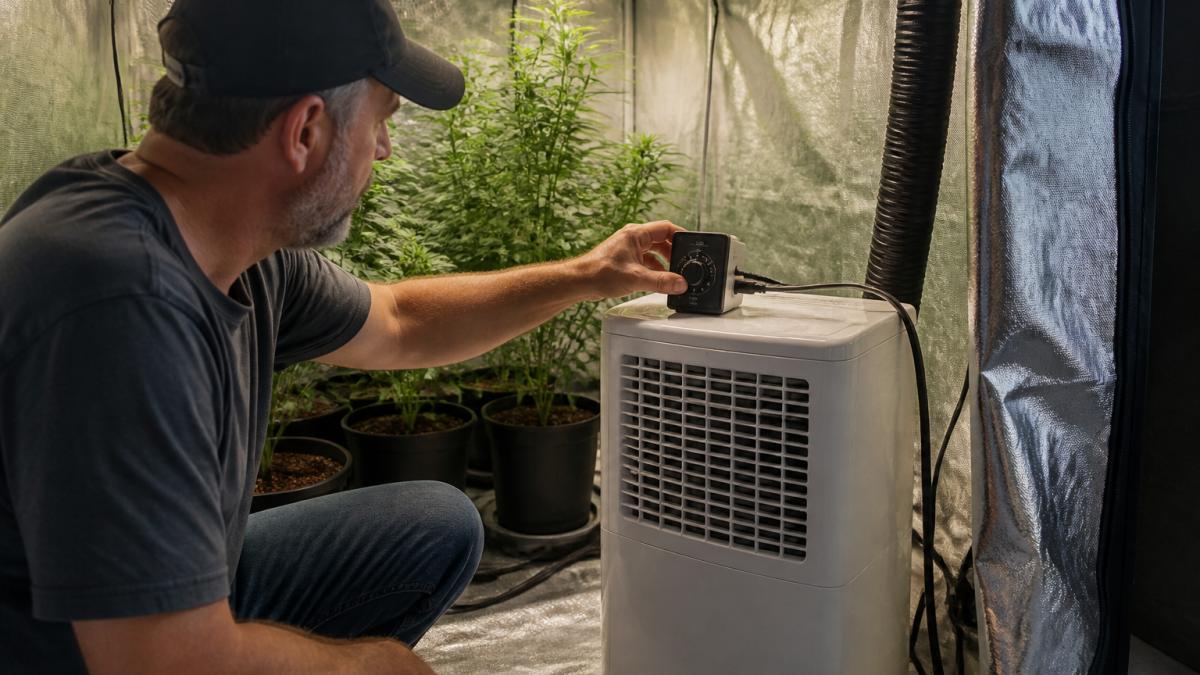
The Gorilla Dual VPD Humidity + Dehumidifier Controller pairs perfectly with a dehumidifier. This controller monitors humidity continuously and triggers your dehumidifier only when needed. It saves energy and prevents over-drying. The dual-channel design lets you run both a humidifier and dehumidifier on separate schedules, perfect for managing day and night cycles.
How to set up dehumidifier control:
Position your dehumidifier near the exhaust point but not blocking airflow. The unit pulls humid air in, removes moisture, and returns dry air to the tent. If you're exhausting air outside, place the dehumidifier before the exhaust point so it cools and dries air before it leaves.
Set the controller to your target humidity. For flowering plants, that's typically 40-50%. The controller will switch the dehumidifier on when humidity rises above your setpoint and off when it drops below it. This creates stable conditions without manual adjustment.
Empty the water tank regularly or use the continuous drainage option. The Gorilla dehumidifier holds 5.5 litres and shuts off automatically when full. For serious growers, the continuous drainage hose eliminates this chore entirely.
Monitor your readings for the first week. Humidity should stay within 5% of your target. If it drifts, check that your ventilation is working properly and the dehumidifier intake isn't blocked.
Common Mistakes to Avoid When Managing Humidity
Most humidity problems stem from a few preventable errors.
Ignoring temperature. Humidity and temperature are linked. Warm air holds more moisture. If your tent runs hot, humidity will be higher than you expect. Cool the space first, then adjust humidity. A 5-degree temperature drop can feel like a 20% humidity increase.
Over-relying on fans alone. A fan moves air but doesn't remove moisture. In naturally damp environments, fans just circulate wet air. You need ventilation that exhausts air outside, not just around the tent.
Watering on a fixed schedule. "Water every three days" ignores actual soil conditions. Overwatering is the number one cause of high humidity. Check soil moisture before watering. Let the top inch dry between waterings.
Closing vents to raise humidity. Yes, it raises humidity temporarily. But it also traps heat, CO₂, and stale air. Plants need fresh air. Raise humidity with a humidifier, not by suffocating your tent.
Switching humidity targets mid-growth. Plants adapt to gradual changes. Sudden swings trigger stress and problems. Plan your humidity schedule before you plant, then adjust slowly.
Measuring humidity in the wrong spot. Place your hygrometer in the middle of the canopy, not near the intake or exhaust. The microclimate around your plants is what matters.
Ignoring night-time humidity. Humidity often rises at night as temperature drops. Your controller should manage both day and night targets. Many growers set day humidity to 50% but forget that night humidity creeps to 70% or higher.
Managing humidity in a grow tent separates successful growers from frustrated ones. The process is straightforward: measure accurately, adjust systematically, and adapt to each growth stage. Start with proper ventilation and a reliable hygrometer.
| Growth Stage | Target Humidity | Key Challenge | Solution |
|---|---|---|---|
| Seedling | 65-75% | Drying out too fast | Humidity dome, frequent misting |
| Vegetative | 50-70% | Balancing growth and air quality | Standard ventilation, monitor daily |
| Pre-flowering | 50-60% | Transition stress | Gradual humidity reduction |
| Flowering | 40-50% | Bud rot risk | Dehumidifier, lower humidity |
| Late flowering | 30-40% | Maximising resin production | Very low humidity, excellent air flow |
Frequently Asked Questions
What humidity should a grow tent be?
Humidity targets vary by growth stage. Seedlings and clones thrive at 60-70% relative humidity (RH). Vegetative plants prefer 40-60% RH, while flowering plants perform best at 40-50% RH to reduce mould risk. Use a hygrometer to monitor levels continuously. The Maxibright Min/Max Thermometer & Hygrometer with Probe tracks these readings and alerts you when conditions drift outside ideal ranges, helping you maintain stable conditions throughout each stage.
How do I know if my grow tent humidity is too high?
High humidity above 60% during flowering creates conditions for powdery mildew and bud rot. Signs include visible condensation on leaves, a musty smell, or slow plant growth. If you spot these issues, increase air exchange by running your extraction fan longer, reduce watering frequency, and consider a dehumidifier. The Gorilla Electric Dehumidifier 26L/Day removes up to 26 litres of moisture daily, making it effective for tents struggling with excess humidity.
Can I control humidity without buying expensive equipment?
Basic steps like improving ventilation, spacing plants further apart, and reducing watering help, but they're often insufficient alone. A hygrometer (starting at £25) is essential to measure what you're actually dealing with. If humidity stays above your target, a dehumidifier becomes necessary rather than optional, moisture damage costs far more than prevention. Automated controllers like the Gorilla Dual VPD Humidity Controller (£95) save time by adjusting equipment automatically based on your set targets.
Does ventilation alone lower humidity in a grow tent?
Ventilation helps by exchanging humid air for drier air outside, but only if the outside air is actually drier than inside your tent. In humid climates or during wet seasons, external air may be equally or more humid, making ventilation ineffective alone. In these cases, a dehumidifier working alongside your extraction fan provides the reliable control you need to prevent mould and maintain plant health.