
Professional Grow Kits: Where to Buy in 2026
Table of Contents
- What Makes a Professional Grow Kit Different
- Complete Grow Tent Kits for Every Space
- Grow Tent Kits with LED Lights: Lighting Systems Explained
- Hydroponic Grow Kits for Maximum Yields
- Grow Tent Kit Sizes: Matching Setup to Your Space
- Total Setup and Running Costs for Professional Grow Kits
- Why Buy Complete Kits Instead of Separate Equipment
- Frequently Asked Questions
Last Updated: October 17, 2026
What Makes a Professional Grow Kit Different
A professional grow kit is a complete, integrated system that optimises growth through controlled environmental conditions, automated feeding, and high-performance lighting.
Many growers start with budget components from multiple suppliers, only to hit incompatibility issues, inefficient light coverage, or ventilation problems. Professional grow kits eliminate that guesswork, engineered for reliability, scalability, and measurable yields.
Every component is selected to work in harmony rather than fight against each other.
What separates a professional kit from a starter kit is capacity, precision, and durability: larger plant volumes, accurate nutrient delivery, and year-round cultivation.
Complete Grow Tent Kits for Every Space
Grow tent kits form the foundation of indoor cultivation, including the tent structure, ventilation ducting, mounting hardware, and often lighting and environmental controls.
Tent size depends on your space and plant count.
Professional-grade tents use reflective mylar lining to maximise light efficiency, reinforced frames for equipment weight, and sealed seams to prevent light leaks. Budget tents often fail here, and light leaks trigger stress responses that reduce yields.
Integrated ventilation ducting keeps air moving: stale air extracted, fresh air drawn in, humidity managed. Without it, you'll face mould, pest issues, and weak plant structure.
Grow Tent Kits with LED Lights: Lighting Systems Explained
LED grow lights are the standard for professional setups: full-spectrum light, cooler running than older technologies, and far less electricity for comparable or superior yields.
Professional LED systems specify their output in PPF (photosynthetic photon flux), measured in micromoles per second.
Full-spectrum LEDs provide the wavelengths plants need across their life cycle, and many professional kits add red light for enhanced flowering, since red wavelengths trigger flowering and increase flower density.
The Maxibright Daylight 315W Full Kit uses CMH (ceramic metal halide) bulbs in a compact reflector.
Hydroponic Grow Kits for Maximum Yields
Hydroponic systems deliver nutrients directly to roots in water, eliminating soil variables and enabling precise control.
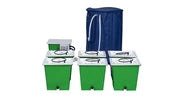
The Green Man Flood & Drain 6 Pot Assembly (£1,050.72) combines deep water culture (DWC) with drip feeding.

A 4" air stone pumps oxygen directly into each reservoir, supercharging root respiration.
For growers scaling beyond single systems, the AutoPot range offers modular flexibility.
The AutoPot (6mm) 48 Pot XL System (£1,560.00) scales this approach to 48 plants in one integrated setup.
For smaller spaces or herb cultivation, the AutoPot Easy2grow Kit (£54.00) is the entry point to hydroponic cultivation.
Grow Tent Kit Sizes: Matching Setup to Your Space
Tent dimensions determine how many plants you can cultivate, what equipment fits inside, and how easily you can control temperature and humidity.
The table below matches common tent footprints to plant counts, lighting, hydroponic systems, and the vertical clearance you actually need.
| Tent Size | Plant Capacity | Suitable Lighting | Best Hydroponic System | Estimated Height Needed |
|---|---|---|---|---|
| 1.2m × 1.2m | 2-4 plants | Maxibright Daylight 315W | AutoPot Easy2grow | 2m+ |
| 1.5m × 1.5m | 4-8 plants | Maxibright Varidrive 2 960W | AutoPot 16 Pot XL | 2m+ |
| 2m × 2m | 8+ plants | Multiple fixtures or high-output LED | Green Man Flood & Drain or AutoPot 48 Pot | 2.2m+ |
Small spaces (flats, bedrooms, cupboards): A 1.2m × 1.2m × 2m tent accommodates 2-4 plants comfortably, fits in a corner, needs only modest extraction, and works with a single LED fixture.
Large spaces (dedicated grow rooms): A 2m × 2m tent or larger accommodates 8+ plants and supports techniques such as sea-of-green (SOG) or screen-of-green (SCROG).
Compatibility checklist before you buy
A tent is only as good as the equipment that fits inside it. Before committing to a size, check these points against the kit you are considering:
Green Man Flood & Drain 6 Pot Assembly →
- Light footprint versus tent footprint. A fixture rated for 1.0m² coverage will underperform in a 1.5m × 1.5m tent. Match the light's stated coverage to the tent's floor area, not to its marketing name.
- Extraction airflow versus tent volume. Calculate tent volume in cubic metres (width × depth × height) and confirm the fan and filter can exchange that volume several times per hour. Undersized extraction is the leading cause of heat and humidity problems.
- Ducting and port sizes. Check that the tent's duct ports match your fan and filter diameters. Adapters exist, but each one adds restriction and noise.
- Hydroponic system footprint. Reservoir and pot layouts must fit inside the tent with room to access plants. A system that technically fits but leaves no working space is a false economy.
- Vertical clearance. Professional growers allocate 300-400mm between the light and canopy during flowering. In a 2m tent with 400mm clearance, you have roughly 1.5m for plant growth, which is realistic for most methods but tight for tall sativa-style plants.
- Upgradeability. If you plan to expand, favour modular systems such as the AutoPot range, which uses 6mm or 9mm piping that connects additional pots and reservoirs without replacing the core kit.
Matching the kit to your experience level
A first-time grower is usually better served by a complete kit in the 1.2m class with a single light and a passive hydroponic system, because there are fewer variables to manage. A grower with a few harvests behind them can step up to a 1.5m tent with a dimmable LED and a modular AutoPot system. Commercial growers should look at 2m and above, where multiple fixtures and larger pot counts justify the additional environmental control equipment.
Total Setup and Running Costs for Professional Grow Kits
A complete professional setup requires investment beyond the kit itself. Understanding total cost, initial purchase plus ongoing operation, prevents budget surprises and helps you compare retailers like-for-like rather than on headline kit price alone.
Initial equipment cost (1.5m × 1.5m tent setup):
- Grow tent kit: £150-300
- LED lighting (Maxibright Varidrive 2 960W): pricing available on request
- Hydroponic system (AutoPot 16 Pot XL): £499.99
- Ventilation and extraction: £100-200
- Environmental controls (thermostat, humidity sensor): £50-150
- Miscellaneous (cables, connectors, timers): £50-100
Total initial investment: roughly £1,000-1,500 for a professional, complete setup.
Monthly running costs:
- Electricity (assuming 960W LED, 12 hours daily): approximately £30-40 per month
- Nutrients and supplements: £20-50 depending on system and plant count
- Water and minor consumables: £5-10
Total monthly operation: approximately £55-100.
How to calculate your own running costs
Electricity is the largest recurring cost and the easiest to estimate. Multiply each device's wattage by its daily hours, divide by 1,000 for daily kilowatt-hours, then multiply by your unit rate in pence per kWh.
Replacement costs are the part most buyers overlook. Carbon filters typically need replacing every 12-18 months depending on humidity and load. LED fixtures last long but are the most expensive component to replace outside warranty, while reservoirs, air stones, and tubing are cheap wear items.
Comparing retailers on total cost, not sticker price
Because the top search results are mostly individual shop category pages, it is difficult to compare what you actually get for the money. When choosing where to buy, compare on these factors rather than the headline kit price:
- What is included. Two kits at similar prices can differ substantially in whether lighting, extraction, ducting, and controllers are bundled or sold separately.
- Delivery. Check whether delivery is included, whether large tents and reservoirs carry a surcharge, and what the expected lead time is.
- Warranty terms. Confirm the warranty period for the tent, light, fan, and any controllers, and whether it is a manufacturer warranty handled directly or through the retailer.
- Returns policy. Large items are awkward to return; check the returns window and who pays return carriage before you order.
- After-sales support. A retailer that knows the kit it sells can diagnose a fault quickly. Ask whether support is by phone, email, or both, and whether spare parts are stocked.
- Upgrade path. A retailer that stocks the modular components for your system makes future expansion simpler and cheaper than sourcing parts elsewhere.
The Growers Shop supplies complete kits and components at every price point. Entry-level systems like the AutoPot Easy2grow (£54.00) let you test hydroponic cultivation for minimal outlay. Mid-range systems like the AutoPot 16 Pot XL (£499.99) deliver professional yields without the complexity of larger installations. Premium systems like the Green Man Flood & Drain 6 Pot Assembly (£1,050.72) are engineered for maximum performance and reliability.
Why Buy Complete Kits Instead of Separate Equipment
The temptation to source components individually is strong: a cheaper tent here, a different LED there, a hydroponic system from another supplier.
Compatibility issues are the first problem. Tent dimensions don't match your light's coverage area. Ventilation ducting doesn't fit your extraction fan.
Support and warranty are clearer. A professional kit comes with integrated support.
Scalability is built in. Professional kits are designed to expand.
Cost per plant is lower.
The Growers Shop's professional kits range from the affordable AutoPot Easy2grow (£54.00) to the high-performance Green Man Flood & Drain 6 Pot Assembly (£1,050.72).
Professional grow kits solve the core problem facing indoor growers: creating a stable, optimised environment without constant adjustment and troubleshooting. Start with the system that matches your space and plant count, and upgrade as your skills and ambitions grow. UK gardening best practices and sustainable indoor cultivation guidelines support the methods professional growers use.
Frequently Asked Questions
What should a professional grow kit include?
A professional grow kit combines grow tent or hydroponic system, LED grow lights or lighting fixture, ventilation equipment, fans for airflow, environmental controls (thermometer, humidity gauge), and nutrient delivery system. The Green Man Flood & Drain 6 Pot Assembly (£1,050.72) includes dual feeding mechanisms for deep water culture and drip irrigation, whilst AutoPot systems add gravity-fed watering without pumps or timers. Complete kits eliminate compatibility issues and provide everything needed from day one.
Are complete grow tent kits worth buying?
Complete grow tent kits save time and reduce compatibility problems. They're designed for specific plant counts and space requirements. For beginners, kits like the AutoPot Easy2grow (£54.00) or Autopot 6mm 1 Pot XL System with Tank (£53.00) provide all essentials without guesswork. Professional growers often choose kits because they're tested systems that deliver predictable results.
How do I choose the right size grow tent kit?
Match kit size to your available space and plant count. Small kits (under £100) suit apartments and single plants; mid-range systems like the Autopot (6mm) 16 Pot XL (£499.99) handle 16 large plants; large systems like the Autopot (6mm) 48 Pot XL (£1,560.00) serve commercial growers. Consider ceiling height, floor space, and heat dissipation. The Maxibright Varidrive 2 960W LED is designed for a 1.5m × 1.5m area. Measure your space first, then select a kit that fits comfortably with room for airflow around equipment.
What's the difference between a grow tent kit and a hydroponic kit?
Grow tent kits use soil or substrate in pots within an enclosed tent with lighting overhead. Hydroponic kits deliver nutrients directly to roots through water solutions, eliminating soil. Hydroponic systems like the Green Man Flood & Drain (£1,050.72) require more monitoring. Soil-based tent kits are simpler for beginners. Both are 'professional' depending on the system's build quality and control features. Choose hydroponic for serious yields; choose tent kits for simplicity and lower startup costs.
Where can I buy a professional grow kit online?
The Growers Shop offers a full range of professional grow kits with UK delivery. Browse hydroponic systems (Green Man, AutoPot ranges from £44.99 to £1,560.00), LED lighting kits (Maxibright Varidrive 2 960W, Maxibright Daylight 315W at £270.00), and complete propagation systems. All kits include full product descriptions, specifications, and compatibility information. Order online and receive discreet delivery to your address. Customer support is available to answer questions about kit selection and setup.