

7 Grow Lights for Houseplants in Winter: Which to Buy
Last Updated: November 1, 2026
Quick Summary
Grow lights for houseplants in winter are best run 12 to 16 hours from November through February as winter supplementation, and only for plants still actively growing. Give light to herbs, seedlings, cuttings, ferns and peace lilies, but skip dormant cacti and succulents.
- Most actively growing houseplants want 12 to 14 hours of light in winter, seedlings and herbs 14 to 16.
- Keep low-power strips 15cm to 30cm above foliage and high-output fixtures 45cm to 60cm above the canopy.
- A 20W strip run 14 hours a day uses 0.28 kWh per day, or 8.4 kWh over a 30-day month.
- Increase exposure gradually over 7 to 10 days, starting at 50% of target intensity or 2 to 3 hours less per day.
- The Cosmorrow COP LED 20W at £19.99 suits shelves and small flats.
Table of Contents
- Why Houseplants Struggle for Light in Winter
- Plants That Need Grow Lights in Winter (and Ones That Don't)
- The Best Grow Lights for Indoor Plants in This Range
- Grow Light Distance From Plants: How Far to Hang Them
- How Many Hours to Use Grow Lights for Plants Each Day
- Measuring Light at the Leaves and Avoiding Winter Light Stress
- Running Costs, Heat and Placement in Real Homes
- Choosing Your Winter Grow Light Setup
- Frequently Asked Questions
Why Houseplants Struggle for Light in Winter
Winter light is the single biggest reason houseplants stall between November and February. Daylight hours shrink, the sun sits lower, and light that passes through glass arrives weaker than it did in summer.
This guide from The Growers Shop covers the grow lights for houseplants in winter that actually earn their shelf space, plus the schedules, distances and running costs that decide whether a fixture helps or scorches.
Here is the part most guides get wrong: not every plant wants more light in winter. Some slow down on purpose, and pushing them only wastes electricity.
Gorilla Grow Tent's guide to grow lights for houseplants recommends running lights for 12 to 16 hours from November through February as winter supplementation. That is a sensible starting window, not a rule for every species.
Plants That Need Grow Lights in Winter (and Ones That Don't)
Plants that need grow lights in winter are the ones still actively growing: herbs on a kitchen shelf, tropical foliage, seedlings and cuttings. Plants that go dormant, including many cacti and succulents, generally do not.
Glowrium's article on winter grow lights makes the point plainly: supplemental lighting helps when winter sunlight is insufficient, but it is not necessary for every houseplant. Click & Grow's winter light guide adds that some houseplants prefer hibernation in shade while others still need light.
Our rule of thumb:
- Give light: herbs, seedlings, cuttings, ferns, peace lilies, and anything putting out new leaves.
- Skip it, mostly: cacti, succulents and other plants resting until spring.
- Watch closely: plants near a bright window may need nothing at all.
The Best Grow Lights for Indoor Plants in This Range
The best grow lights for indoor plants depend on the space you have, not the price tag. We group our range into three practical tiers: strips for shelves, strips for medium rooms, and complete stations.
| Fixture | Price | Best For |
|---|---|---|
| Cosmorrow COP LED 20W | £19.99 | Shelves and small flats |
| Gorilla Propagation LED 8W | £19.99 | Seedlings and cuttings |
| Maxibright Daylight Pro 60W | £150.00 | Medium rooms |
| Maxibright Daylight Pro 100W | £170.00 | Larger rooms |
| Maxibright Varidrive 360W | £120.00 | Tents up to 1.2m |
| Secret Jardin Original 60 | £407.16 | Propagation stations |
| Secret Jardin For Twenty 100 | £407.16 | Full-cycle stations |
Compact Strip Lights for Shelves and Small Flats
Small spaces do not need big fixtures. The Secret Jardin Cosmorrow COP LED 20W is a good fit for shelves and tight corners at £19.99. It is a compact, waterproof 24V strip that screws, clips or hangs using the fasteners in the separately sold Cosmorrow Power Supply.
For propagation, the Gorilla Propagation LED 8W at £19.99 delivers a 6500K spectrum with 16 µmol/s output and mounts above propagators on its support bar.
Full-Spectrum Strips for Medium Rooms
Medium rooms need coverage, not just intensity. The Maxibright Daylight Pro Strip 60W puts out 168 µmol/s at 2.8 µmol/J, dims from off to 100%, and carries IP65 waterproofing. At £150.00 it suits a shelving unit or a small spare room.
Step up to the Maxibright Daylight Pro Strip 100W at £170.00 for 280 µmol/s across a longer 1120mm body. Both link together, so you can extend coverage without buying a second controller.
High-Output Fixtures and Complete Grow Stations
If you want a ready-made setup, the Secret Jardin For Twenty 100 Grow Station at £407.16 includes dimmable full-spectrum LED lighting and a web plant support for heavier flowers and fruits. The Original 60 Grow Station at the same price uses 6500K cold white light for cloning and microgreens.


For tent growers, the Maxibright Varidrive 360W at £120.00 delivers 1040 µmol/s at 2.89 µmol/J across 0.8m to 1.2m spaces, with onboard dimming and passive cooling.
Grow Light Distance From Plants: How Far to Hang Them
Grow light distance from plants is the difference between steady growth and bleached leaves. As a working rule, keep low-power strips 15cm to 30cm above foliage and high-output fixtures 45cm to 60cm above the canopy, then adjust by watching the plants.
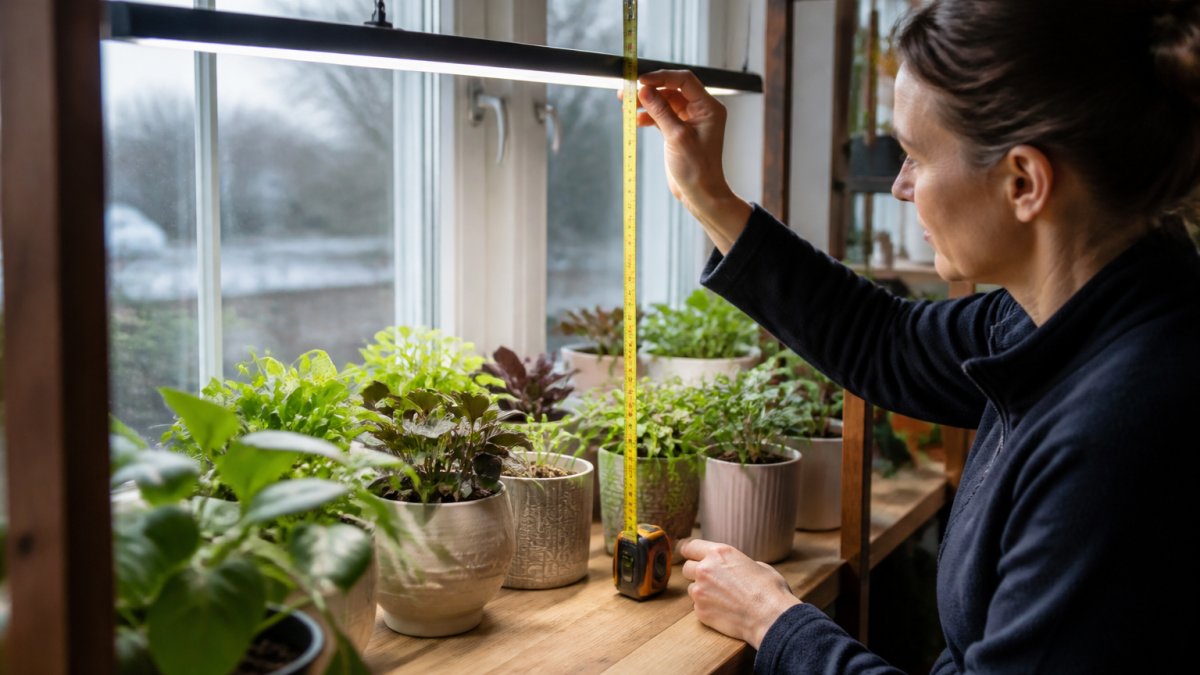
A common mistake is hanging a powerful fixture at strip height. Match the gap to the wattage and the plant's needs.
How Many Hours to Use Grow Lights for Plants Each Day
How many hours to use grow lights for plants each day comes down to species and season. Most actively growing houseplants want 12 to 14 hours in winter, seedlings and herbs 14 to 16, and dormant plants none at all.
Secret Jardin Cosmorrow COP LED 20 Watt PPE 2.85 µmol/J L50cm (Full Spectrum) →
A plug-in timer removes the guesswork. Set it to switch on at first light and off before you go to bed, and keep the dark period uninterrupted. Plants need darkness to respire properly, so running lights around the clock does more harm than good.
Watch out: leaving a bright fixture on 18 hours a day in a small flat builds heat and dries leaves faster than most people expect.
Measuring Light at the Leaves and Avoiding Winter Light Stress
Measuring light at the leaves beats guessing from a spec sheet. A lux meter held at canopy height gives a rough sense of the light the plant receives.
Here are general winter targets by plant type:
- Low-light foliage (peace lily, pothos, ferns): 3-6 mol/m²/day DLI, or roughly 50-100 µmol/m²/s for 12-14 hours. A 20W strip at 20-30cm is ample.
- Medium-light tropicals (monstera, philodendron, spider plant): 6-12 mol/m²/day, or 100-200 µmol/m²/s for 12-14 hours. A 60W strip at 30-45cm works well.
- High-light herbs and seedlings (basil, parsley, tomatoes): 12-20 mol/m²/day, or 200-400 µmol/m²/s for 14-16 hours. A 100W fixture at 30-45cm is more appropriate.
- Dormant cacti and succulents: 0-3 mol/m²/day; no supplemental light needed unless you are trying to break dormancy.
If you do not have a meter, watch the plants. Light stress shows up as bleached or curled top leaves, scorched edges, or a washed-out colour on new growth.
Winter acclimation matters as much as the final setting. Do not move a plant from a dim corner to full fixture output overnight.
For deeper guidance on reading plant signals, our expert guidance for indoor plant cultivation walks through the practical checks.
Running Costs, Heat and Placement in Real Homes
Running costs stay modest with LEDs, but you can work out the exact figure for your setup. The method is simple: multiply wattage by daily hours, divide by 1,000 to get kilowatt-hours (kWh), then multiply by your electricity unit rate. For example, a 20W strip run 14 hours a day uses 0.28 kWh per day. Over a 30-day month that is 8.4 kWh.
The bigger heat risk is placing a fixture too close to foliage, which can scorch leaves even at low wattage. Keep a gap of at least 15cm between any LED and leaf surfaces, and more for higher-wattage fixtures.
Placement in real homes is where most guides stay generic. Here are practical solutions for common situations:
- Windowsills: A strip mounted on a shelf bracket above the window works well, but cold glass causes condensation. Mount the fixture at least 10cm back from the glass and check for drips. South-facing sills get the most winter light; use supplemental lighting only on cloudy weeks or for high-light plants.
- Shelving units: One 20W strip per shelf tier is usually enough for low- to medium-light plants. Run the strip along the front edge of the shelf above, angled slightly back, so light reaches the whole row. Linkable strips let you run one power supply across several shelves.
- Hanging fixtures: For a single large plant or a small cluster, a pendant-style fixture hung from a ceiling hook gives even top-down light. Keep the fixture 45-60cm above the tallest leaf and adjust the chain as the plant grows.
- Small spaces: In a studio or tight corner, a clip-on strip or a compact 8W propagation light takes up no floor space. Mount it on a shelf edge or a windowsill bracket.
- Plants of different heights: Group plants by light need, then set the fixture height for the tallest plant and use a small riser (a stack of books or an upturned pot) to bring shorter plants closer to the light. Alternatively, use two fixtures at different heights on a tiered shelf.
Watch out: condensation on cold window glass can drip onto a fixture mounted too close, so leave a gap. Route cables away from walkways and never cover a strip with fabric or a curtain.
Choosing Your Winter Grow Light Setup
Choosing a winter setup means matching wattage to space, then letting a timer handle the schedule. Start with one strip per shelf, measure at the leaves, and add fixtures only when growth stalls.
At The Growers Shop we stock the range shown above, from £19.99 strips to complete grow stations.
Frequently Asked Questions
How many hours a day should I use grow lights for houseplants in winter?
Most houseplants do well with 12 to 14 hours of supplemental light per day through winter, switched on in the morning and off in the evening with a plug-in timer. Start at 12 hours, watch how the plant responds over a fortnight, and add an hour if growth is pale or stretched.
How far should a grow light be from houseplants?
The right grow light distance from plants depends on output. Start with a larger gap and lower the light gradually while watching the plants. Hold your hand at leaf height for a minute: if it feels uncomfortably warm, raise the light.
Do grow lights put off a lot of heat?
LED grow lights produce far less heat than older high-pressure sodium lamps, which is why they suit small flats and shelves. Heat still builds up in a closed room, so keep lights clear of curtains and check the temperature around the leaves rather than the room as a whole.
Are LED grow lights good for houseplants?
Yes. Modern LED grow lights deliver usable light at a fraction of the running cost of older lamp types, and full-spectrum versions cover the range houseplants use for steady growth. A 20 W full-spectrum strip costs £19.99. Higher-output strips with dimming, such as the 60 W and 100 W Maxibright Daylight models, give you control as plants grow.
Can succulents and cacti grow under artificial light in winter?
Succulents and cacti are among the plants that need grow lights in winter most, because they want strong light and will stretch and pale on a dim windowsill. Reduce watering alongside the lighting change, since a plant under lights but sitting in wet compost will still rot.
Winter light is short and unforgiving, and guessing at wattage, distance and hours wastes both electricity and plants. The Growers Shop supplies compact strips, full-spectrum fixtures and complete grow stations with expert guidance for indoor growing, so you can match the right light to your space and schedule. Browse the range and get your winter setup running before the darkest weeks arrive.
