

Is Professional Grow Equipment Overkill for Home Growers?
Last Updated: October 28, 2026
Quick Summary
Not for everyone. Professional grow equipment is gear built for consistent, high-output cultivation, and what matters most is how well it controls light, air and temperature rather than brand prestige. Start with essential kit and upgrade only where your results show a clear gap.
- Split your kit into three tiers: essential, useful and optional.
- Upgrade extraction before buying a bigger light if lights-on temperature runs more than 5°C above room temperature.
- Fix humidity above roughly 60-65% in late flowering before anything else, as it is a mould risk.
- A compact starter setup in a 0.75m x 0.75m tent costs roughly £250-£450 to start.
- Run a full grow cycle after each change before deciding on the next upgrade.
Table of Contents
- What Counts as Professional Grow Equipment?
- Essential Grow Equipment: A Tiered Checklist
- Is a Grow Tent Worth It for Your Space?
- Do Professional Grow Lights Justify the Extra Cost?
- Cost Comparison by Setup Size and Growing Method
- The Risks of Under-Equipping and Over-Equipping
- How to Upgrade a Grow Setup Without Overspending
- Choosing Your Next Step: Starting Small With a BudBox-Pro Tent
- Frequently Asked Questions
What Counts as Professional Grow Equipment?
Professional grow equipment is any gear built for consistent, high-output cultivation rather than occasional growing. At The Growers Shop, we carry full grow tent kits, high-performance grow lights and specialised nutrients, so we see the full range of what home growers buy. Put simply, the difference is less about brand prestige and more about how well a piece of kit controls light, air and temperature.
The key question to ask of any item is simple: does it solve a problem you actually have?
Essential Grow Equipment: A Tiered Checklist
Not every grower needs the same setup. A useful way to think about it is to split kit into three tiers.
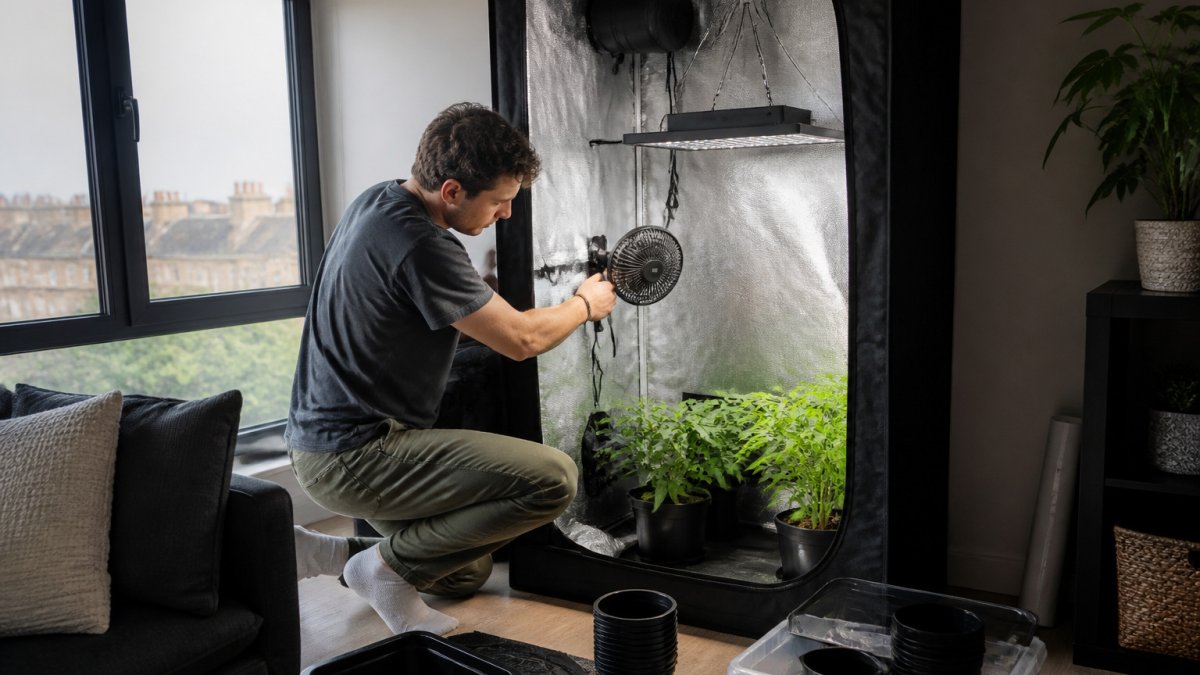
Tier 1: Essential (you cannot grow well without these)
- A contained space such as a grow tent or cupboard
- A light suited to your plant stage
- An extraction or circulation fan to move air
- A way to measure temperature and humidity
- Basic nutrients for the growth stage you are in
Tier 2: Useful (worth adding once Tier 1 works)
- A fan controller to adjust speed
- A carbon filter for odour control
- A timer for lighting cycles
- A dehumidifier if your room runs damp
Tier 3: Optional (for experienced or larger grows)
- Upgraded lights with higher output
- Ducting and inline fans for larger spaces
- Automated environmental controllers
Is a Grow Tent Worth It for Your Space?
Tents are fast to set up, easy to move and keep the rest of the room clean. You can browse complete grow tent kits to see bundled prices for a full setup. They also make it easier to hold a steady temperature. That said, a tent takes up floor space and needs ventilation, so check the footprint before you buy.
The BudBox-Pro 0.75m x 0.75m model is available in silver at £94.99 or white at £102.50. Both have steel push-and-click connectors and powder-coated poles.
Watch out: a tent without proper ventilation can trap heat and humidity fast, which invites mould. Plan your extraction before you plan your plants.
Do Professional Grow Lights Justify the Extra Cost?
The main things to compare are coverage area, output and heat. A light that runs hot can push a small tent beyond a comfortable temperature, so output alone does not tell the full story. Look for the coverage figure from the manufacturer and match it to your tent size.
BudBox-Pro Tent 0.75m x 0.75 x 1 (Small) Silver →
Cost Comparison by Setup Size and Growing Method
| Setup size | Typical footprint | Core kit included | Indicative startup cost | Typical ongoing cost focus |
|---|---|---|---|---|
| Compact starter | 0.75m x 0.75m tent | Tent, mid-range LED, basic extraction fan, timer, thermometer/hygrometer | £250-£450 | Electricity for light and fan; nutrients |
| Intermediate home grow | 1.2m x 1.2m tent | Tent, higher-output LED, carbon filter and inline fan, fan controller, basic nutrients | £550-£950 | Electricity, filter replacement, nutrient top-ups |
| Larger or multi-stage | 1.5m+ tent or dedicated room | Full kit, ducting, environmental controller, upgraded extraction, monitoring | £1,200-£2,500+ | Electricity, filter and bulb replacement, controller upkeep, water use |
Soil versus hydroponic costs
Soil growing has a lower equipment floor. You need pots, compost and basic nutrients, but no pumps, reservoirs or water-quality monitoring. The trade-off is that soil is heavier to move, takes more floor space per plant, and you may need to replace compost between cycles.
Ongoing running costs
Consumables matter too. Carbon filters typically need replacing every 12-18 months in continuous use. Nutrients are a per-cycle cost that scales with plant count and reservoir size. Soil growers buy compost; hydroponic growers buy pH adjustment and calibration solutions.
The Risks of Under-Equipping and Over-Equipping
Both mistakes cost money, but they fail in different ways and at different times. The useful question is not whether professional equipment is overkill in the abstract, but which specific risks you are carrying with your current setup.
What under-equipping looks like
Under-equipping rarely announces itself. It shows up as a pattern across a grow cycle:
- Temperature creep. If your tent runs more than 3-5°C above the room temperature during lights-on, your extraction is probably undersized for the light. A common target is to keep the canopy within a few degrees of ambient.
- Humidity spikes. Relative humidity climbing above roughly 60-65% in late flowering is a mould risk. If you see condensation on leaves or tent walls, extraction or circulation is failing.
- Uneven growth. Plants at the edges of the tent stretching or producing less suggests your light coverage is too narrow for the footprint.
- Stalled development. Slow growth despite adequate feed often points to poor air exchange, the plants are not getting enough CO₂ or are sitting in stale, humid air.
What over-equipping looks like
Over-equipping is easier to spot because you paid for it:
- Heat you cannot remove. A high-output light in a small tent pushes temperatures past what a basic fan can handle. You then spend more on extraction and controllers to solve a problem you created by oversizing the light.
- Capacity you never use. A controller with eight channels running two devices, or a reservoir sized for a commercial run feeding four plants, is wasted spend.
- Complexity that causes mistakes. More sensors, more calibration, more failure points. Many growers buy automated environmental controllers and never set the schedules properly, which is worse than a simple timer.
- Higher running costs for no gain. A 600W light in a 0.75m tent does not produce twice the result of a 300W light; it produces heat stress and a bigger electricity bill.
A simple threshold test
Before you upgrade, check three numbers against your current setup:
- Lights-on temperature versus room temperature. If the gap is consistently above 5°C, fix extraction before buying a bigger light.
- Late-flowering relative humidity. If it sits above 60%, add extraction, circulation or a dehumidifier before anything else.
- Light coverage versus tent footprint. If the manufacturer's coverage figure is smaller than your tent floor, you have a coverage gap, not a power gap.
How to Upgrade a Grow Setup Without Overspending
- Track your current results: yield, temperature, humidity and any problems.
- Find the weakest point: airflow, light coverage or nutrient control.
- Fix that one area first.
- Run a full grow cycle before changing anything else.
- Repeat only when the data shows another clear gap.
Choosing Your Next Step: Starting Small With a BudBox-Pro Tent
The BudBox-Pro tent is available in a compact size. Our professional grow kits page shows what is available now.
The BudBox-Pro 0.75m tent is available at £94.99 in silver or £102.50 in white.
The Growers Shop offers full grow tent kits.
Frequently Asked Questions
Is professional grow equipment overkill for a beginner?
The BudBox-Pro Tent 0.75m x 0.75 x 1 (Small) is available at £94.99 in silver or £102.50 in white.
Is a grow tent worth it for a small indoor garden?
The BudBox-Pro Tent 0.75m x 0.75 x 1.6 (Intermediate) is available at £98.99 in silver or £103.99 in white.
Are professional grow lights worth the extra cost?
They can be, but only when your plants need the output. Higher-quality lights deliver more usable light over a larger canopy and tend to be more efficient per watt, which matters if you run lights for long periods. For a small tent with a few plants, a mid-range light often gives comparable results. Consider professional lights when you outgrow your current coverage area or want to shorten your growing cycle.
When should you upgrade to professional grow equipment?
Upgrade when you can measure a limit. Signs include uneven canopy growth that suggests poor light coverage, humidity that stays above your target despite extraction, repeated mould problems, or a tent that is too cramped for the plants you want to grow. Track these issues for a few cycles before spending. A staged upgrade, changing one item at a time, makes it easier to see what actually improved your yield.
