

How Grow Lights Work for Plants and How to Use Them
Last Updated: November 10, 2026
Quick Summary
Grow lights work by converting electricity into the wavelengths plants absorb for photosynthesis, mainly in the 400 to 700 nanometre range growers call PAR. Blue light drives compact leafy growth, red light supports flowering and fruiting, and full-spectrum fixtures mimic sunlight most closely.
- Plants absorb usable light in the visible range of roughly 400 to 700 nanometres, known as PAR.
- Blue light around 400-500nm drives leafy, compact growth, while red light around 600-700nm supports flowering.
- Start a propagation LED around 15-30cm above seedlings and lift it as plants grow.
- Most indoor plants want 12-16 hours of light per day with an uninterrupted dark period each night.
- A 200W LED run 16 hours a day at 24p per kWh costs about 77p daily, roughly £23.50 a month.
Table of Contents
- How Grow Lights Work for Plants: Light as Plant Food
- Grow Light Spectrum and Wavelength Explained Simply
- Measuring Light Properly: PAR, PPFD and DLI
- Getting Grow Light Height for Seedlings Right
- How Long to Leave Grow Lights On at Each Stage
- Heat, Running Costs and Choosing the Right Fixture
- Set Up Your First Grow Light with the Right Kit
- Frequently Asked Questions
How Grow Lights Work for Plants: Light as Plant Food
A grow light is an artificial light source that gives plants the energy they need to grow when natural sunlight isn't enough. Light is plant food, and a grow light is simply a delivery system for it.
Here's the part most guides skip. Plants don't "see" light the way we do. They absorb specific wavelengths and use that energy to turn water and carbon dioxide into sugar. That process is photosynthesis, and it's the engine behind every leaf, root and flower.
Below, we'll show you exactly how that works, which colours matter, and how to set up a light that actually delivers results.
But first, here's what most guides get wrong: they treat all light as equal. It isn't. A cheap bulb and a proper full-spectrum fixture can look similar to the eye and behave completely differently in a grow tent.
Turning Electricity into the Wavelengths Plants Absorb
A grow light takes electric current and converts it into light across a range of wavelengths. Plants absorb most of that energy in the visible light range, roughly 400 to 700 nanometres. Growers call this band PAR, or photosynthetically active radiation.
Not every wavelength does the same job:
- Blue light (around 400-500nm) drives leafy, compact growth
- Red light (around 600-700nm) supports flowering and fruiting
- Far-red light sits just beyond what we see and influences plant shape
The mix matters more than the total output. Research published in a peer-reviewed plant growth study found that different blue-light combinations produced noticeably different plant performance, which tells you spectrum choice is not a minor detail.
Why Full-Spectrum Light Beats a Single Colour
Single-colour bulbs have their place, mostly in propagation. But a full-spectrum light mimics natural sunlight more closely, so plants get the full range they've evolved to use.
Grow Light Spectrum and Wavelength Explained Simply
Light spectrum is the range of colours a grow light produces, measured in wavelengths. Plants use different parts of that range for different jobs, so the spectrum shapes how a plant grows, not just how fast.
Think of it as a set of instructions. Blue tells a plant to build structure. Red tells it to reproduce. Get the balance wrong and you'll see it in the foliage within weeks.
Blue Light for Roots, Leaves and Compact Growth
Blue light keeps plants stocky and strong. Seedlings grown under blue-heavy light tend to develop thicker stems and shorter gaps between leaves, which is exactly what you want early on.
This is why propagation LEDs are usually blue-balanced. The Gorilla Propagation LED 8W with Support Bar, for example, is a propagation LED designed for seedlings and cuttings, supplied with a support bar and suction cup mounting system.
Red and Far-Red Light for Flowering and Fruiting
Once a plant moves into flower, red light takes over. It signals the shift from vegetative growth to flower production, and far-red light helps shape how the plant stretches and fills out.
A common mistake is running a blue-heavy propagation light all the way through flowering, which can keep plants compact. Switching to a fuller spectrum when you move into flower is the usual approach.
Measuring Light Properly: PAR, PPFD and DLI
PAR is the light plants can use. PPFD is how much of that light lands on a given spot each second. DLI is the total your plant receives across a full day.
Those three terms cover almost everything a hobby grower needs. Wattage tells you what the fixture draws from the wall, not what reaches the leaves.
A PAR meter helps you measure light rather than guess. The Maxibright PAR Meter measures from 0 to 3999 μmol/m²/sec with a large LCD display.
| Term | What It Measures | Why It Matters |
|---|---|---|
| PAR | Usable light range | Defines what plants can absorb |
| PPFD | Light hitting a spot per second | Shows intensity at canopy level |
| DLI | Total light over a day | Ties intensity to duration |
| Lux | Brightness to the human eye | Not a plant measure |
Watch out: lux readings from a phone app tell you almost nothing about plant-usable light. Use them for rough comparison only.
Getting Grow Light Height for Seedlings Right
Seedlings need gentle light close to the canopy. Start a propagation LED around 15-30cm above the tray, then lift it as the plants grow. Too far and they stretch; too close and you risk scorching.
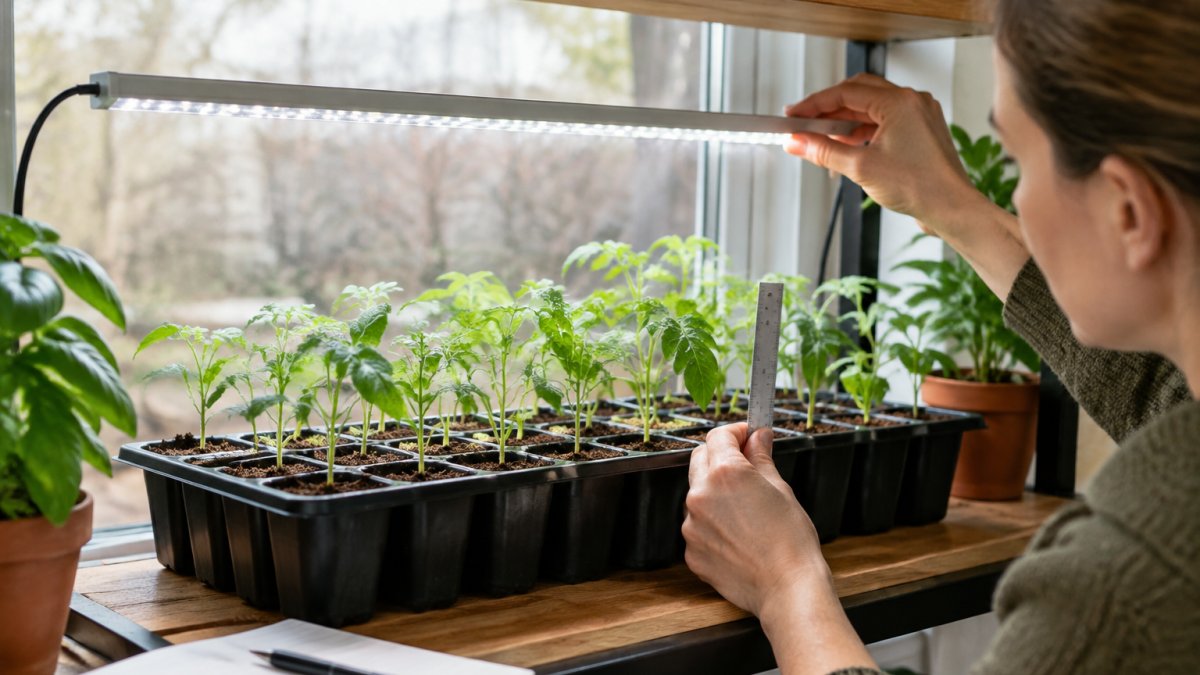
Check height every few days. Seedlings grow fast, and a light that was perfect on Monday can be touching leaves by Friday.
For a full breakdown by fixture type and growth stage, read our guide on how far LED grow lights should be from plants.
How Long to Leave Grow Lights On at Each Stage
Most indoor plants want 12-16 hours of light per day, with a dark period every night. Seedlings usually sit at 14-16 hours. Vegetative plants do well at 16-18. Flowering plants often run 12 hours on, 12 off.
Darkness is not downtime. Many plants need an uninterrupted dark period to develop properly, and light leaks during that window can disrupt flowering.
A plug-in light timer removes the human error. Set it once and leave it.
- Seedlings and cuttings: 14-16 hours
- Vegetative growth: 16-18 hours
- Flowering: 12 hours
- Houseplants in winter: 12-14 hours
Recommended grow light hours per day by growth stage
Heat, Running Costs and Choosing the Right Fixture
LED fixtures run cooler and use less electricity than older fluorescent tubes, and modern LEDs deliver more usable light per watt. That matters in a small flat where heat and running costs add up quickly.
Running cost is simple arithmetic: watts divided by 1,000, multiplied by hours per day, multiplied by your electricity unit rate in pence per kWh. A 200W LED run for 16 hours a day uses 3.2 kWh per day. At a unit rate of 24p per kWh, that is about 77p per day, or roughly £23.50 over a 30-day month. A 400W fixture on the same schedule doubles that to about £47 a month. Check your own unit rate on your energy bill or smart meter, because rates vary by tariff and region.
Heat output follows wattage closely. A 200W LED releases roughly 200W of heat into the room, similar to a small heater on low. In a sealed tent or a cupboard, that heat accumulates, so you need extraction or airflow to stop the canopy overheating. Fluorescent tubes spread heat along their length and are gentler close to seedlings, but they deliver less usable light per watt, so you run more of them for the same result.
Check four things before you buy:
- Coverage area matched to your tent or shelf footprint, not the headline wattage
- Wattage suited to the space, with headroom for flowering
- Heat output and airflow around the canopy
- Efficiency in micromoles per joule (μmol/J) where the manufacturer publishes it, because a higher figure means more plant-usable light for each unit of electricity
A common pattern is buying an oversized fixture for a small space, then fighting heat and paying for light that spills outside the canopy. Match the fixture to the footprint first. If you are growing houseplants through winter, our roundup of grow lights for houseplants in winter covers the fixtures that suit low-light months. For tight spaces, see our picks for grow lights for small apartments.
Watch out: a fixture that feels cool to the touch at the driver can still push canopy temperatures up by several degrees in a closed tent, so measure at leaf level rather than at the housing.
Set Up Your First Grow Light with the Right Kit
A first setup doesn't need to be complicated, but it does need a feedback loop. Follow this order, then read the plant rather than the packaging.
- Measure your space and note the coverage you need
- Pick a full-spectrum fixture sized to that space
- Mount it at the recommended height for your growth stage
- Set a timer for the right photoperiod
- Check PPFD at canopy level, or start conservatively
- Adjust height weekly as plants grow
- Watch leaves for stress and respond early
The first two weeks are a sensible period for observation rather than optimisation. Set the light, then look for these signals:
- Stretching or long gaps between leaves: the light is too far away or too weak. Lower the fixture or increase intensity gradually.
- Bleaching or pale patches near the top: light is too intense or too close. Raise the fixture or shorten the photoperiod.
- Crisp, scorched leaf edges: heat or low humidity at the canopy. Improve airflow and lift the light.
- Poor flowering or slow transition: spectrum or photoperiod is wrong for the stage. Move to a fuller spectrum and confirm the dark period is uninterrupted.
- Small, slow growth with healthy colour: likely too little daily light. Increase hours before increasing intensity.
Adjust one variable at a time and wait a week before changing anything else, otherwise you cannot tell what worked. A plug-in timer removes human error on the photoperiod, and a PAR meter removes guesswork on intensity.
If you'd rather start with everything matched, our full grow tent kits bundle lighting with the rest of the equipment. For a straightforward LED option, the Secret Jardin Cosmorrow Cop LED Kit 200W Full Spectrum is a complete full-spectrum setup.
Watch out: buying a light before measuring the space is the most common first mistake. Match the fixture to the footprint first, and the rest falls into place.
Getting light right is the difference between plants that survive and plants that thrive. The Growers Shop stocks full-spectrum LED fixtures, propagation lights, PAR meters and complete grow tent kits, with guidance to match each one to your space and stage. Get started with The Growers Shop and give your plants the light they actually need.
Frequently Asked Questions
Do grow lights actually work for indoor plants?
Yes, provided the light is strong enough and covers the plant's leaves evenly. Grow lights emit the wavelengths used in photosynthesis, so a plant under a suitable fixture can photosynthesise just as it would in daylight. The limit is intensity and duration: a weak strip placed far away delivers too little usable light, and the plant stretches or stalls. Match the fixture to the plant's stage, keep the distance sensible, and run it on a timer.
How far should grow lights be from seedlings?
Low-wattage propagation strips are designed for close positioning, often 5-15 cm above the tray, because their output is gentle and spreads a short distance. Raise the light if seedlings stretch towards it or show bleached, curled leaves. A PAR meter helps you measure rather than guess: the Maxibright PAR Meter measures 0 to 3999 μmol/m²/sec.
Can grow lights be left on for 24 hours?
Most plants need a dark period to run the processes that light interrupts, so 24-hour lighting is rarely the right choice outside early propagation of some cuttings. A common approach is 16 hours on and 8 hours off during vegetative growth, shortening to around 12 hours on and 12 off to encourage flowering. Use a plug-in timer so the schedule stays consistent, and watch for stress signs such as drooping or yellowing if you push the hours up.
Do grow lights use a lot of electricity?
Running costs depend on wattage and hours, and modern LEDs are modest. A 12W propagation strip used 16 hours a day draws roughly 0.19 kWh daily, which is pennies on a standard tariff. Larger flowering fixtures use more, so compare wattage before buying and check the stated efficiency. The Gorilla Propagation LED 8W quotes 2.0 µmol/J efficacy.
